
Why React Hooks Break?
A deep dive into how React tracks hooks internally using an indexed system—and why breaking hook order causes bugs, crashes, and chaos.
🧩 Introduction

Sounds dramatic.
But React isn’t angry.
👉 It’s just extremely strict about order.
⚠️ The Core Rule (Most Important Line)
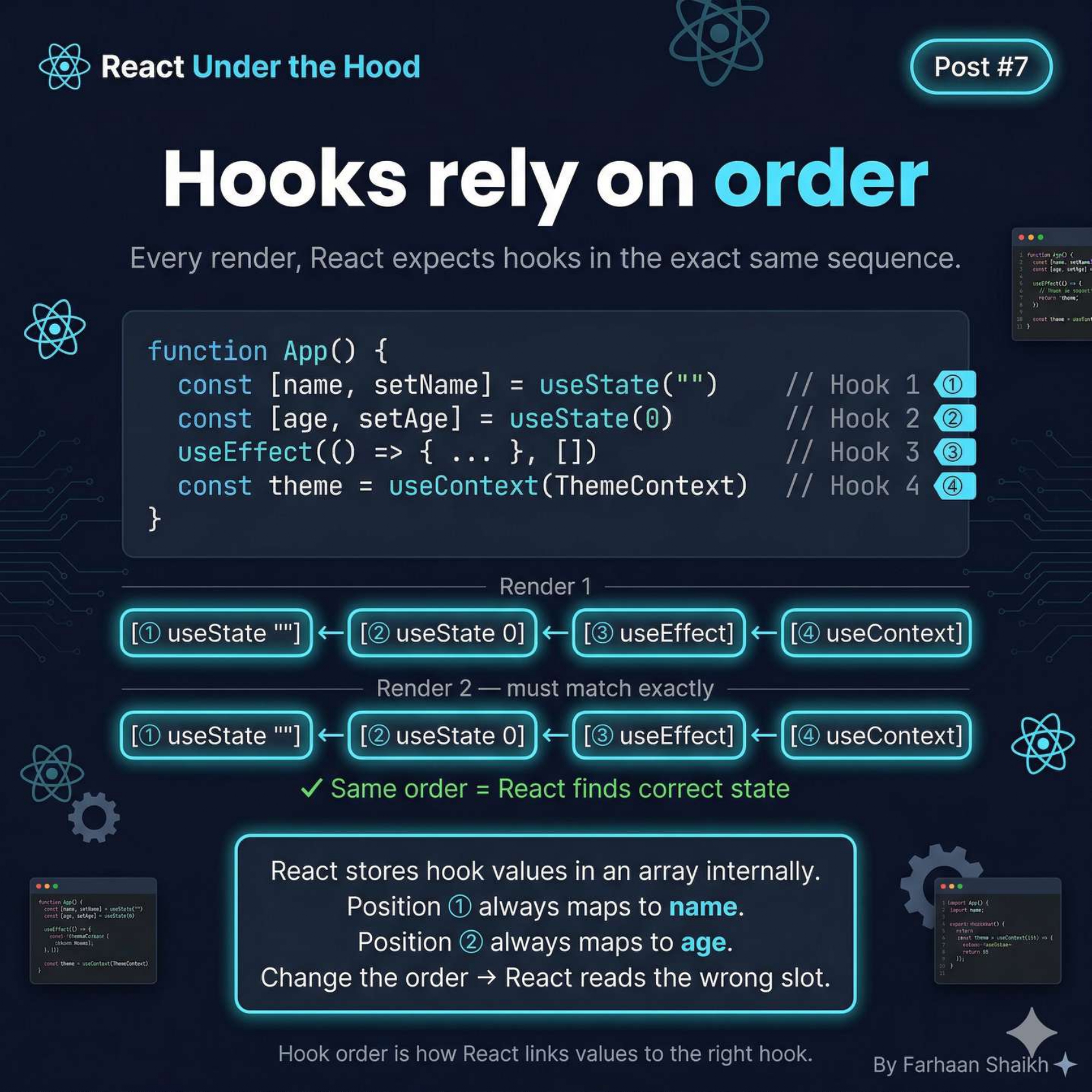
👉 Every render must call hooks in the same sequence
Example:
javascript
function App() {
  const [name, setName] = useState("");
  const [age, setAge] = useState(0);
  useEffect(() => {}, []);
  const theme = useContext(ThemeContext);
}
👉 React internally sees this as:
plain text
Hook 0 → useState (name)
Hook 1 → useState (age)
Hook 2 → useEffect
Hook 3 → useContext
Next render MUST match this exactly.
Otherwise?
👉 💥 Things break.
🧠 What’s Actually Happening Internally
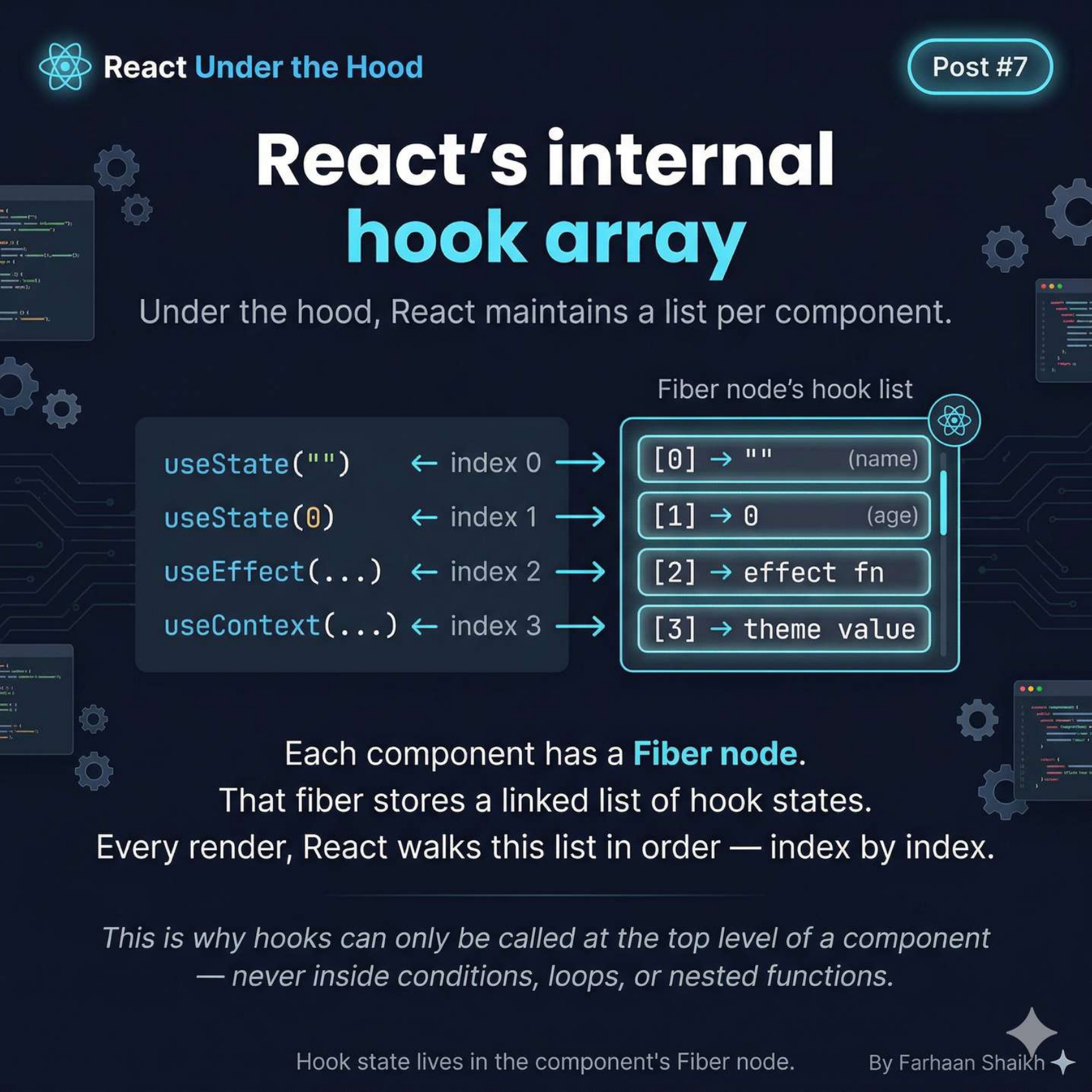
Internal structure (simplified):
javascript
hooks = [
  "",        // name
  0,         // age
  effectFn,  // useEffect
  themeVal   // useContext
];
👉 Each component has something called a Fiber node
👉 That Fiber stores this hook list
Key insight:
👉 React does NOT use variable names
👉 It only uses position (index)
⚙️ Index-Based Tracking (The Real System)
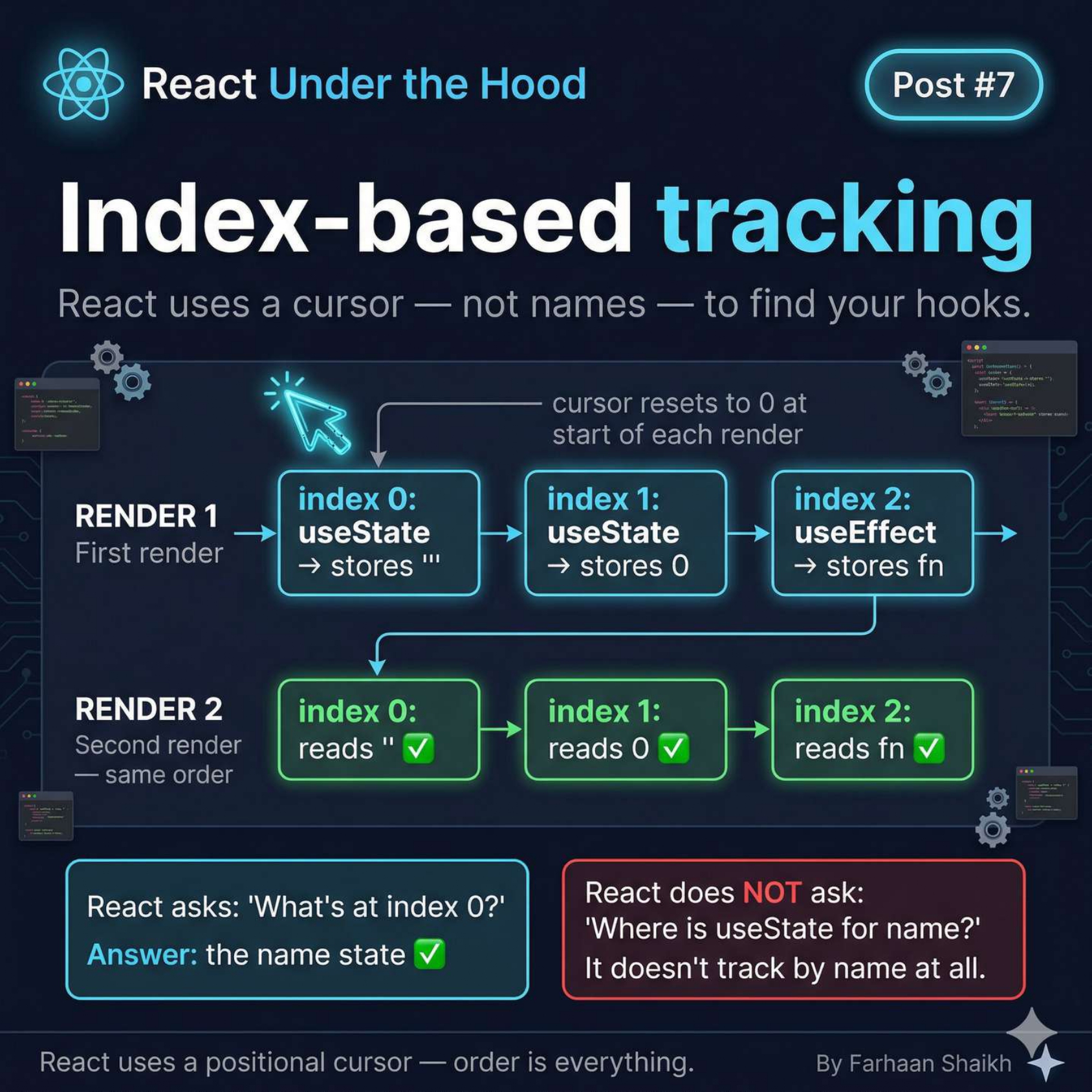
On every render:
- Cursor starts at 0
- First hook → index 0
- Second hook → index 1
- And so on…
👉 React literally asks:
Not:
This is the entire system.
💥 The Biggest Mistake (Where Bugs Come From)
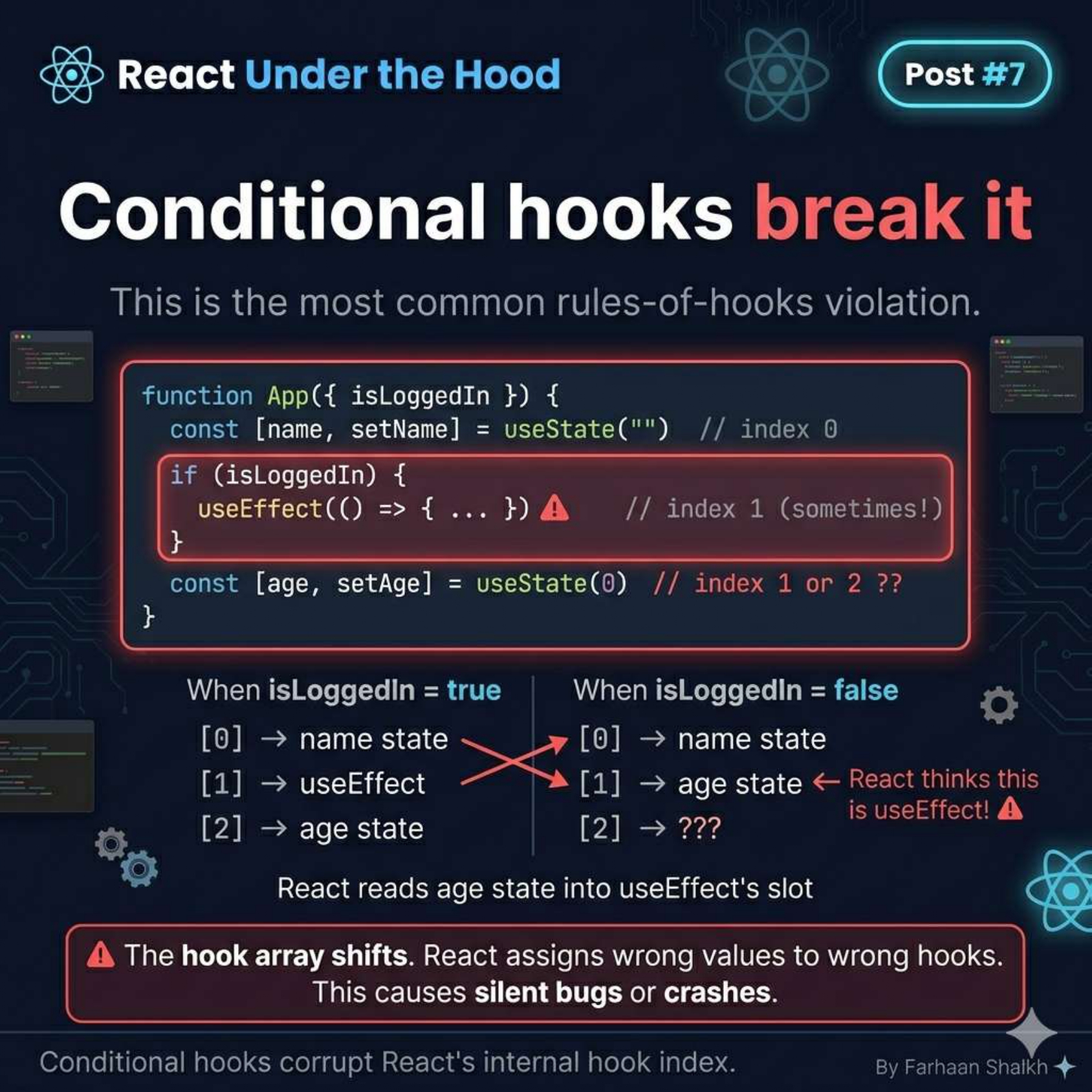
Bad code:
javascript
function App({ isLoggedIn }) {
  const [name, setName] = useState("");

  if (isLoggedIn) {
    useEffect(() => {});
  }

  const [age, setAge] = useState(0);
}
What happens?
Render 1 (isLoggedIn = true):
plain text
[0] useState (name)
[1] useEffect
[2] useState (age)
Render 2 (isLoggedIn = false):
plain text
[0] useState (name)
[1] useState (age) ❌
👉 Now React thinks:
- index 1 = useEffect
- but actually it’s useState
👉 💥 Mismatch = chaos
🧪 The Bug in Action
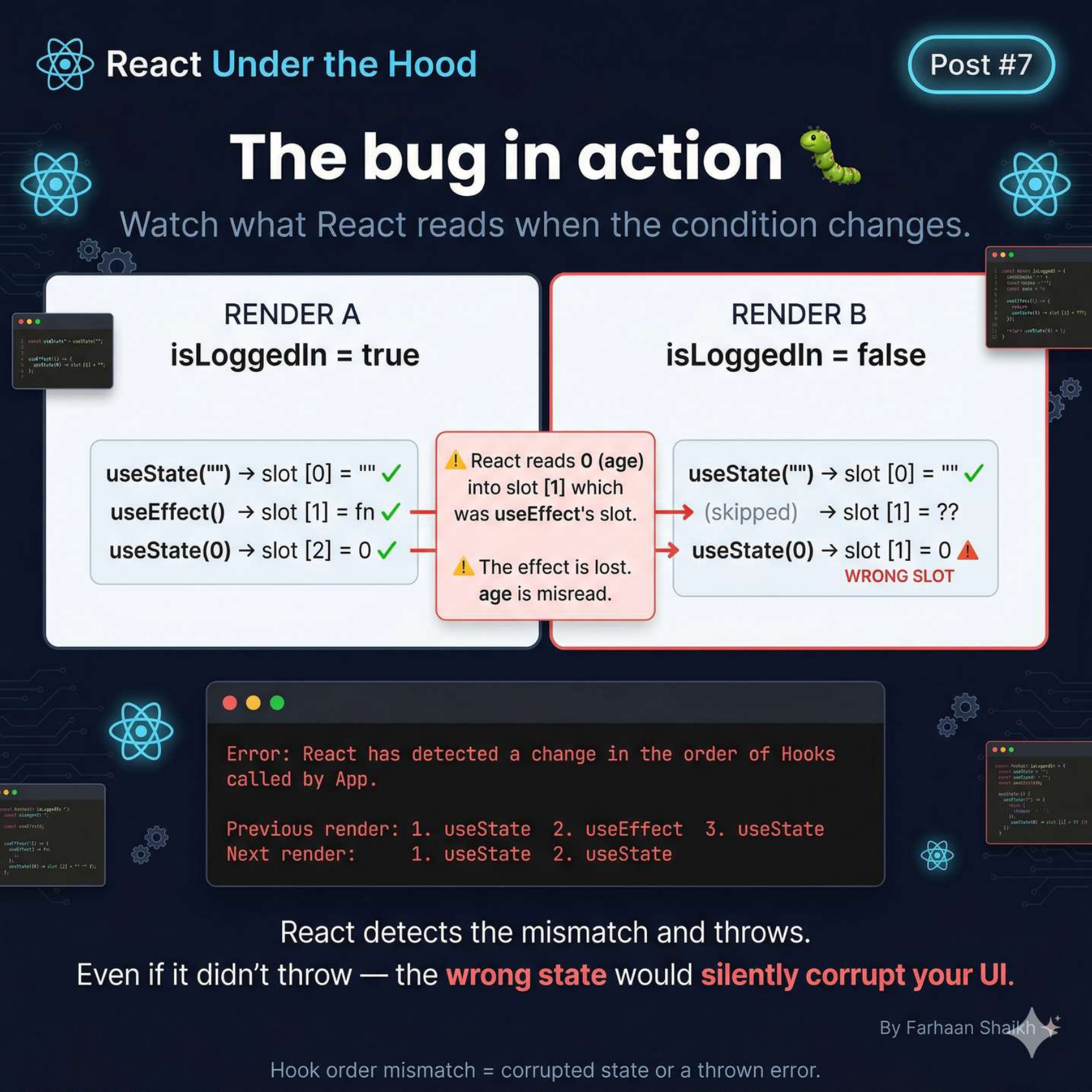
What breaks:
- Effects disappear
- State shifts
- Wrong values assigned
- UI behaves randomly
Sometimes you’ll see:
plain text
React has detected a change in the order of HooksWorse case:
👉 No error
👉 Silent UI corruption 😬
🧠 Why These Rules Exist (Not Arbitrary)
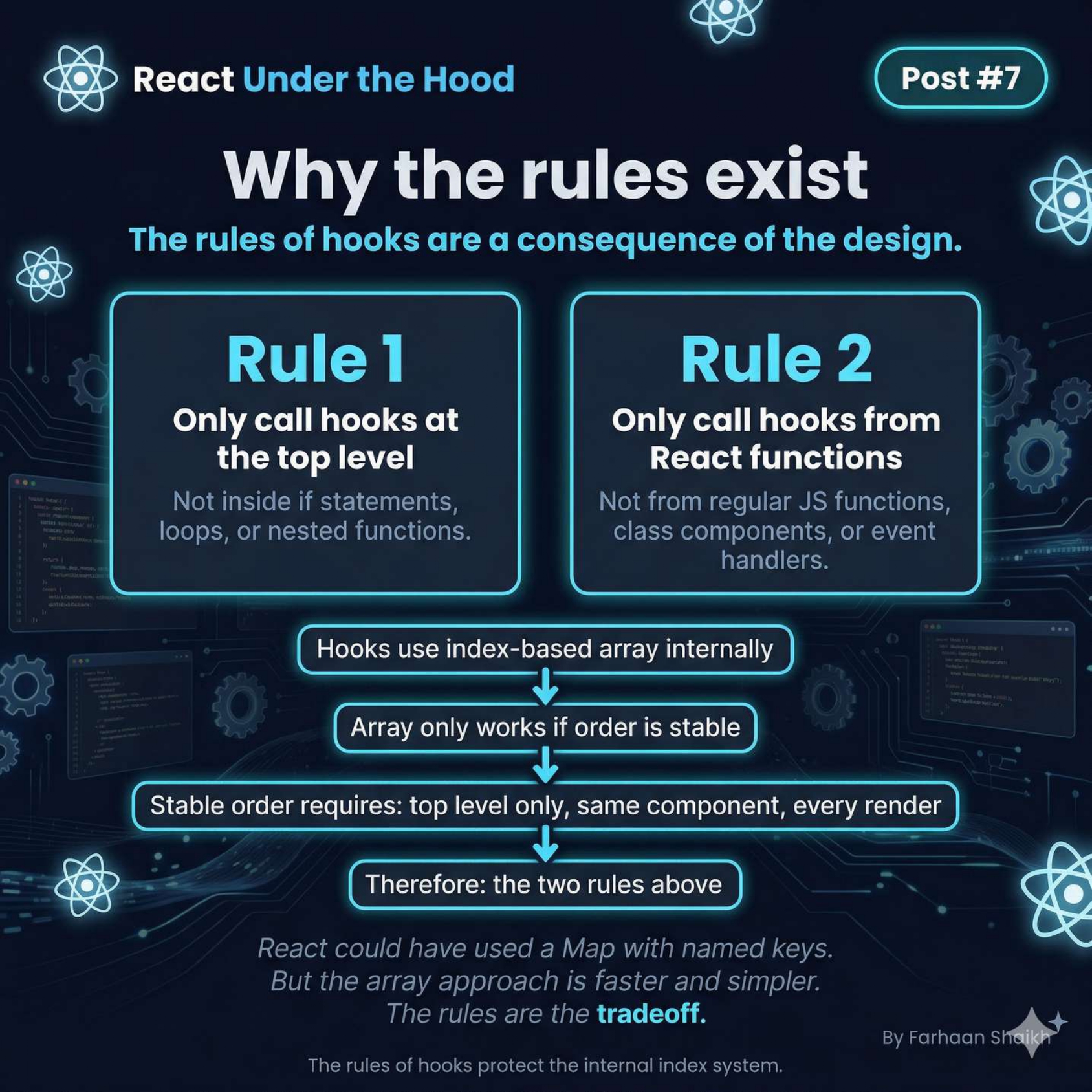
React could have done:
javascript
Map<"name", value>But instead chose:
javascript
Array[index]Why?
- Faster
- Simpler
- Less overhead
Tradeoff:
👉 You must maintain order
📏 The Two Rules of Hooks
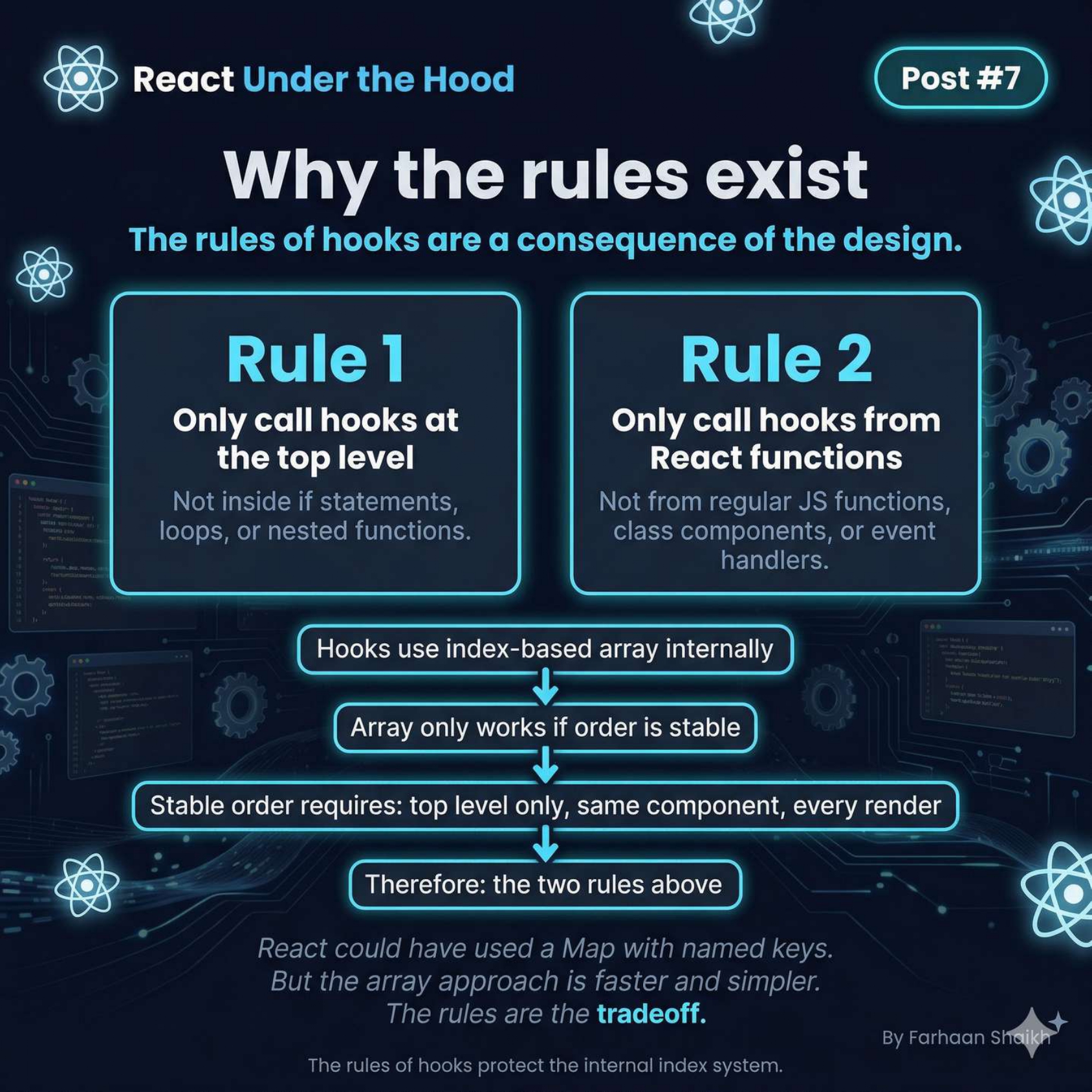
✅ Rule 1
Only call hooks at the top level
❌ Not inside:
- if statements
- loops
- nested functions
✅ Rule 2
Only call hooks from React functions
❌ Not in:
- regular JS functions
- event handlers
- class components
👉 These rules exist to protect the index system
🛡️ ESLint Saves You
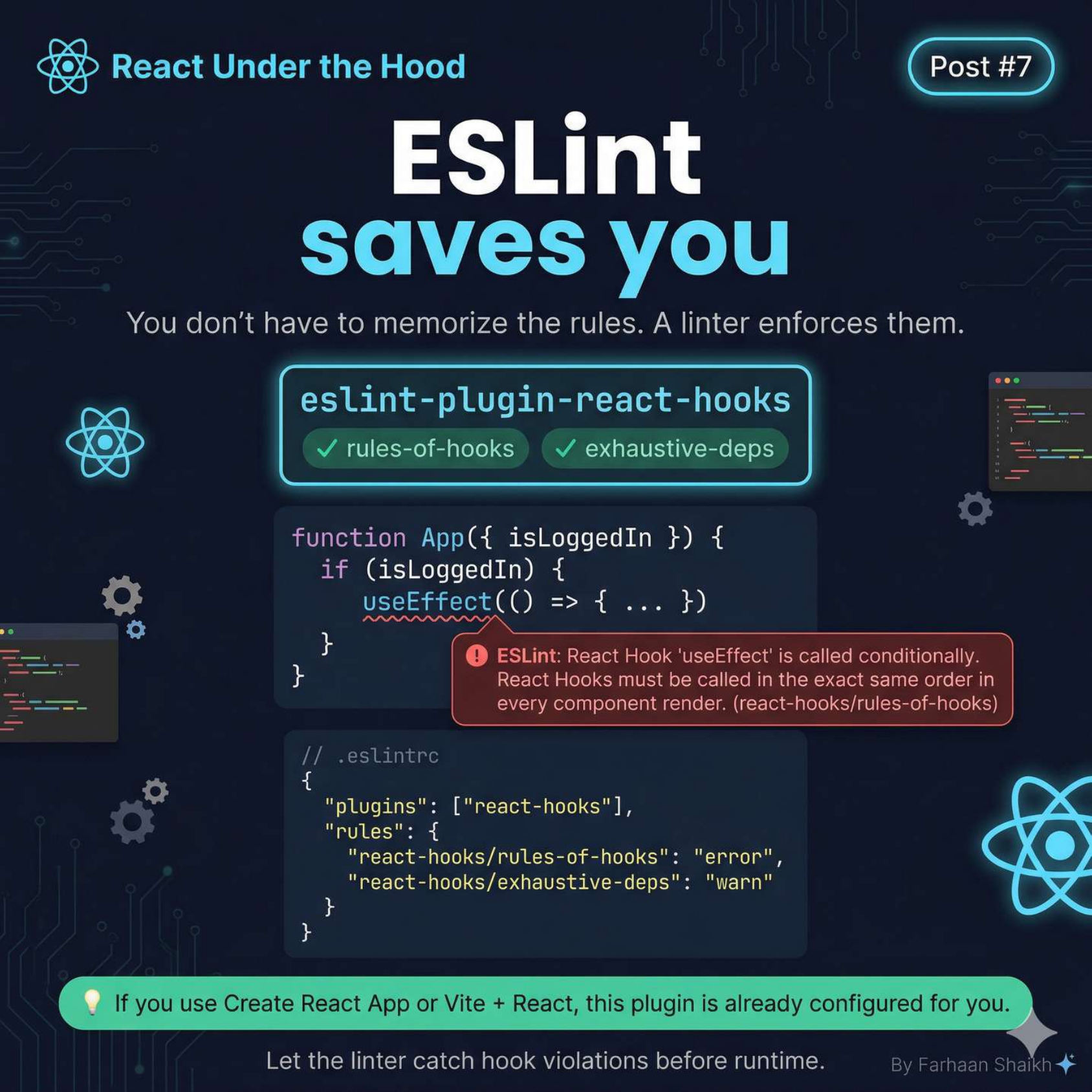
Plugin:
bash
eslint-plugin-react-hooksWhat it catches:
- Conditional hooks
- Missing dependencies
- Wrong usage patterns
👉 This is why you rarely see hook bugs in production
👉 Because ESLint stops you early.
🧠 Final Mental Model
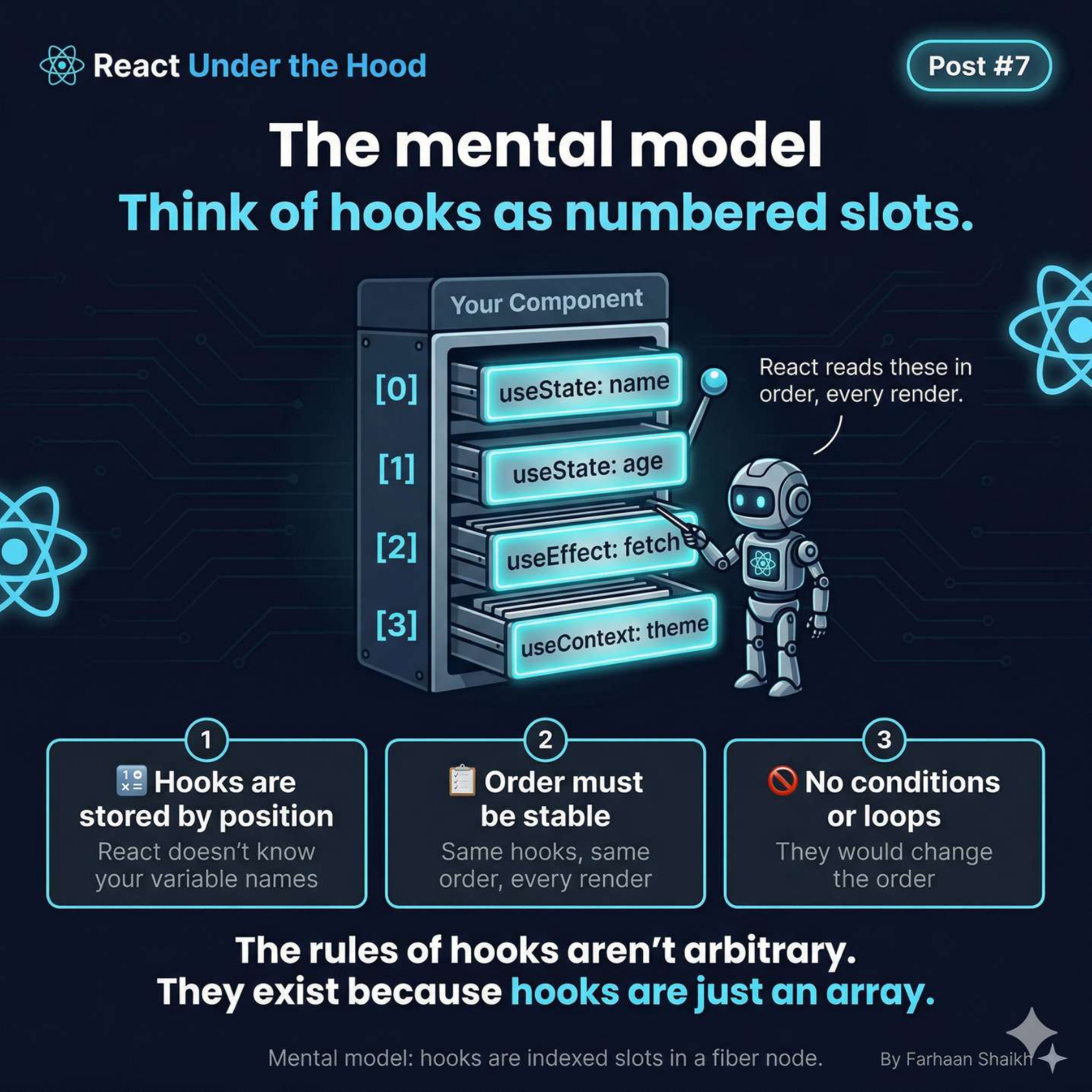
Visualize:
plain text
[0] → name
[1] → age
[2] → effect
[3] → context
👉 Every render:
- React walks this list
- In order
- Same positions
Golden truth:
👉 Hooks are NOT magic
👉 They are just array slots
🎯 Final Takeaways

- Hooks depend on order
- React uses index, not names
- Conditional hooks break the system
- Rules exist to maintain stability
- ESLint protects you
One-line clarity:
👉 Hooks work because their order never changes.
🔥 Mindset Shift
❌ “Hooks are smart”
✅ “Hooks are positional”
🚀 What You Just Learned
You now understand:
- Why hook rules exist
- What React does internally
- Why conditional hooks break things
- How React maps state correctly
- Why ESLint is critical
🔜 Next Post Teaser
👉 useEffect Deep Dive
- When effects actually run
- Cleanup logic
- Dependency array truth
- Why infinite loops happen
If you want next level:
I can help you:
- Convert this into viral LinkedIn post (your style)
- Turn this into blog article with diagrams
- Or go deeper into Fiber + hook linked list internals
Just say 👍